
Breaking · Semiconductor Equipment · DUV Lithography
China’s Domestic DUV Breakthrough: Validation, Not Yet a Verdict
A Shanghai state-owned entity says it will ship immersion DUV lithography tools to SMIC, Hua Hong, and CXMT starting August 2026. Markets reacted instantly. The technology has not.
I. The Breakthrough
Multiple outlets report that China has begun producing its own immersion DUV lithography machines — the workhorse tool for mature and mid-node chip production, and a category China has never mass-manufactured domestically at scale.
LEAD
ENT.
ENT.
Manufacturer
“Ai Sheng Na Electronics Technology Group”
Shanghai state-owned enterprise, founded August 2023, registered capital exceeding RMB 7 billion.
CLI
ENTS
ENTS
Planned Delivery
SMIC · Hua Hong Semiconductor · CXMT
First deliveries expected from August 2026.
PROD
PLAN
PLAN
Ramp Schedule
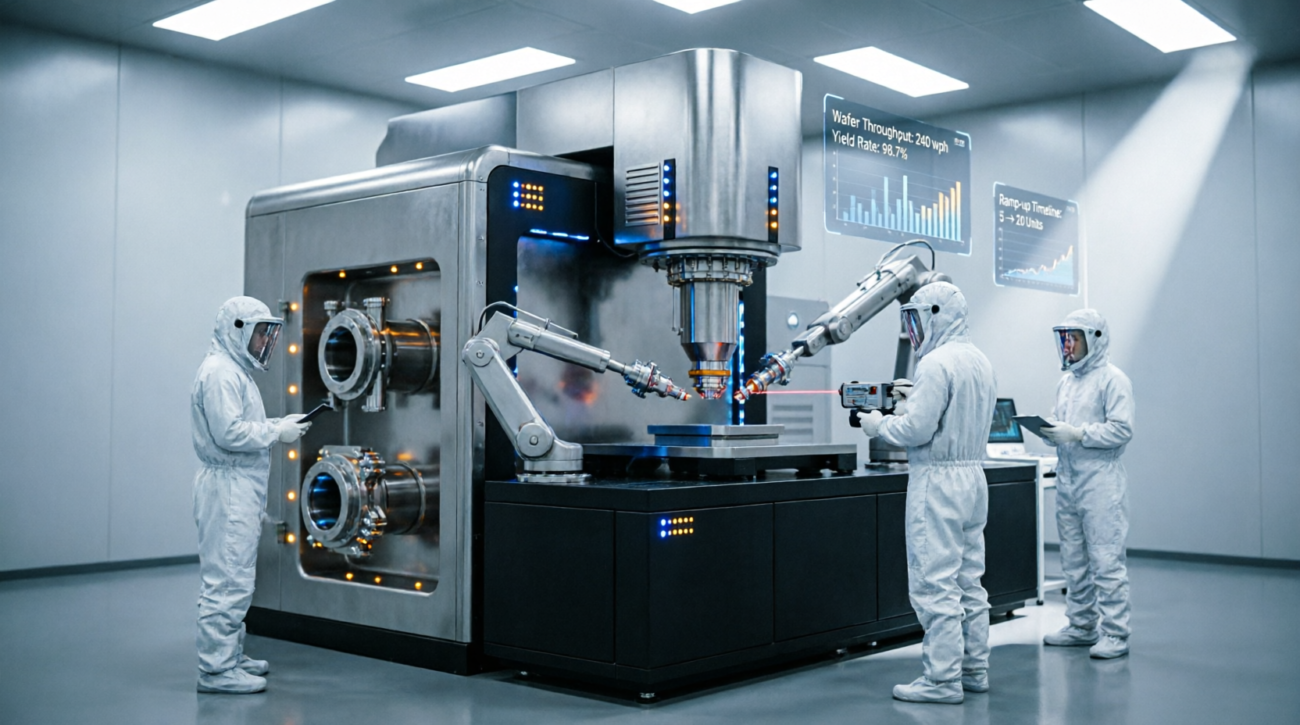
~5 units (2026) → ~20 units (2027)
A four-fold scale-up targeted within a single year.
-5.8%
ASML share reaction
-14%+
SK Hynix share reaction
131
ASML units delivered, 2025
Why this matters: With Washington tightening semiconductor equipment export controls, a domestic DUV alternative — however immature — offers Chinese chipmakers a hedge against future restriction. That narrative alone was enough to move ASML, SK Hynix, and Samsung on the day of the report; Samsung Electronics also fell more than 13%.
II. Current Performance
The tools remain in the testing and validation phase. Precision and throughput lag materially behind ASML’s mature immersion DUV systems, which shipped 131 comparable units in 2025 alone. The gap is not merely one of unit count — it is process maturity accumulated over decades.
III. Feasibility of the Production Targets
~5 units — 2026
Likely achievable
The bar is assembly and delivery of validation prototypes, not qualified volume production. Deliveries start in August, leaving adequate runway to hit this target.
~20 units — 2027
Highly challenging
Chip manufacturing demands proven yield, overlay accuracy, throughput, and long-term reliability — all unverified at scale. Some critical components still depend on Japanese imports, an exposure to further restriction. Scaling 5 units to 20 is a four-fold jump that strains both supply chain and assembly capacity.
Expert read: Optimists call this a milestone breakthrough. Most analysts and academics estimate reaching ASML-comparable quality is still three to four years out — meaning no direct commercial threat to ASML in the near term.
USINO.AI view — bottom line: The 5-unit goal tests technological validation; the 20-unit goal tests industrialization capability. Expect the former to land. The latter is the number that will actually tell you whether China has built a lithography industry or a lithography prototype.