
Beijing’s Robot Arena: What 2,056 Machines Actually Proved
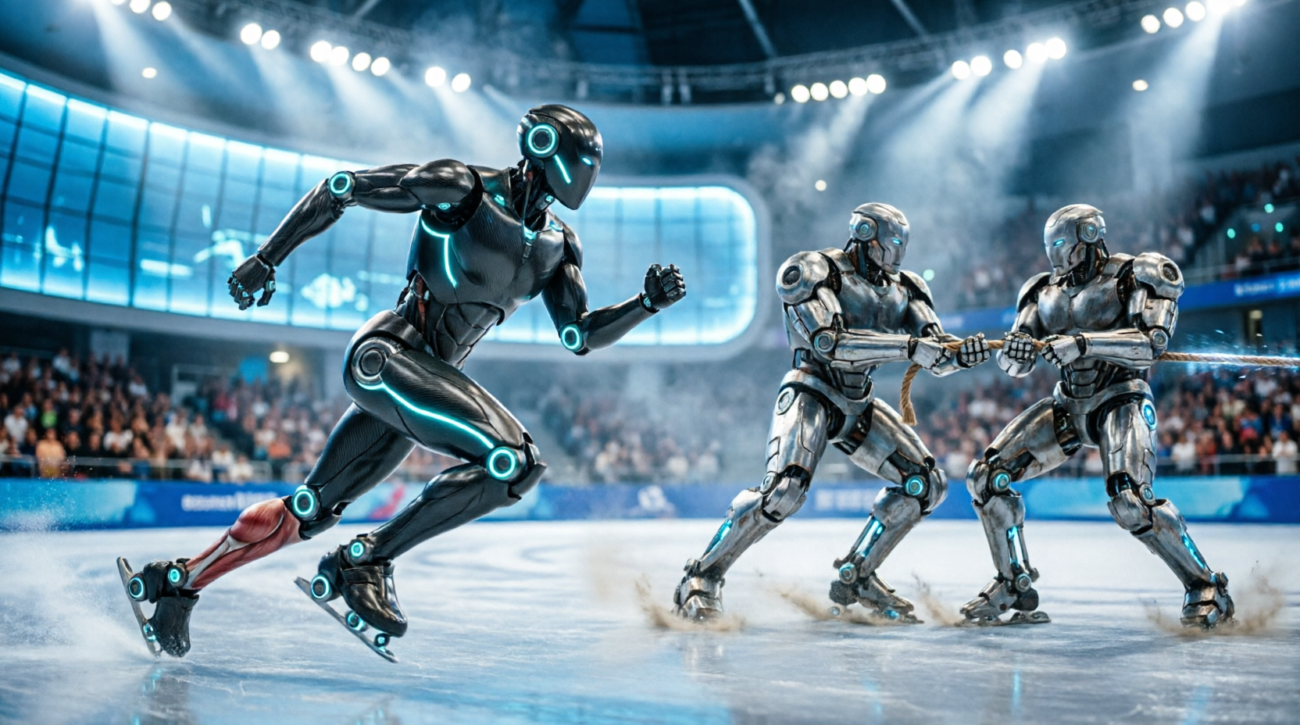
The 2nd World Humanoid Robot Games opened at Beijing’s National Speed Skating Oval this week with 2,056 robots and 666 teams from 16 countries — more than triple the scale of the inaugural 2025 edition. The record-breaking sprints are what traveled. The more durable signal is a rule organizers wrote into the scoring: full autonomy earns full points, remote human piloting earns half. That’s a cleaner progress report on embodied AI than any highlight reel, and the frame this brief uses throughout.
Why the Sprint Times Are the Wrong Story
Two “world record” 100m claims came out of Beijing this week, and they are not the same fact. Honor’s robot “Lightning” ran 9.32 seconds in an unofficial trial before the Games opened — the team controlled the conditions. X-Humanoid’s robot ran 9.39 seconds inside judged, opening-day competition. Both beat Usain Bolt’s 9.58-second human record; only one was earned under scrutiny. Coverage that flattens the two is coverage to discount. The number that actually separates real capability from a controlled demo is the teleoperation penalty built into the work-scenario events — see below.
The Records, So Far
The Supply Chain Read-Through
1. The Scoring Rule Is the Real Data
Flat-ground sprinting requires full autonomy. Obstacle courses and weightlifting permit a human operator by teleoperation. The 20 work-scenario events — the ones modeled on factory, hotel, warehouse and home tasks — award full points only for autonomous completion and cut the score in half for anything piloted. Eight of those events are dexterous-hand tasks: power-tool assembly, bricklaying, fastening, cable connection — precisely where teleoperation still shows up most. That gap, not the sprint times, is what to track over the next twelve months.
2. Honor’s Two Bets on the Same Idea
Honor fielded both Flash and Lightning, and separately shipped a consumer phone this month with a 200-megapixel, motorized titanium gimbal camera that extends from the chassis. Read together: the humanoid is the R&D-facing proof that Honor’s actuator and vision-tracking stack competes with dedicated robotics firms; the gimbal phone is the same expertise already generating retail revenue, years before a humanoid is priced for a mass consumer.
3. The Ecosystem Underneath
Unitree and X-Humanoid dominate the medal counts and the headlines. The clearer supply-chain signal sits a few kilometers away at the concurrent World Robot Conference (Aug 19–23), which drew 300+ exhibitors (+36% YoY), 2,000+ exhibits and 150+ first-launch products, and hosted China’s first Central Enterprise Robotics Pavilion with 49 state-owned enterprises. On-site, the Games’ own “Robot Home” support center can house 1,500+ robots and charge 1,200+ batteries at once — logistics built for a scale nobody needed to plan for a year earlier.
On July 29, 2026, the U.S. FCC banned new imports of foreign-made humanoid and quadruped robots, citing supply-chain and national-security risk and naming China specifically. China’s Foreign Ministry called it protectionism. The timing — five weeks before Beijing put 2,056 robots, 96% of them Chinese-built, in front of a global audience — closes Unitree, X-Humanoid and Honor’s largest addressable Western export market just as the Games showcase them to it.
Competitive Landscape: Who’s Actually Winning
What Matters for Positioning
- Autonomy is now an auditable metric, not a marketing claim: the teleoperation penalty in the work-scenario events is the clearest public signal available of how much “autonomous” humanoid work still runs through a human operator.
- Supply-chain concentration is a headline number: 641 of 666 teams and 1,975 of 2,056 robots at the Games were Chinese — the organizers’ own participant count, not an inference.
- Regulatory bifurcation is accelerating: the FCC’s July ban narrows the Western export path for Unitree, X-Humanoid and Honor just as domestic scale-up (the Robot Home, the WRC exhibitor floor) is accelerating.
- Consumer crossover is arriving early: Honor’s Robot Phone shows the same actuator and vision R&D that wins a robot race can monetize at retail years before a humanoid is priced for a household.
Company Watch
Unitree — Hangzhou X-Humanoid — Beijing Honor — Shenzhen
USINO.AI tracks the Asian supply chain behind every Physical AI headline — components, capacity, and the companies the market hasn’t priced yet.