USINO.AI · Policy & Supply Chain
Beijing Answers Back: Inside China’s Countermeasures to the FCC’s Optical Transceiver Ban
Within a day of Reuters reporting that Washington was drafting a ban on Chinese-made optical transceivers, Beijing had five separate countermeasures on the table. The exchange is a live case study in how fast the AI supply chain now escalates — and where the pressure points actually sit.
The cadence of US-China tech friction has compressed to nearly real time. On August 4, Reuters reported that the Federal Communications Commission was drafting rules to bar imports of new Chinese-made optical transceivers — the components that convert electrical signals to light inside every AI data center rack — citing concerns over data theft, malware, and service disruption. Washington hopes to finalise the rule before year-end, though officials cautioned it remains a draft and could still be softened or shelved, as an earlier version of the policy once was.
By August 5, China’s Ministry of Commerce had already responded — not with a single retaliatory gesture, but with a coordinated package spanning entity lists, export controls, certification bodies, and a new national security probe. For an investor tracking the Physical and Virtual AI supply chain, the sequence is worth reading closely: it shows precisely which levers Beijing reaches for first, and which parts of the stack are treated as most exposed.
A Draft Rule Aimed at the Data Center’s Nervous System
Optical transceivers sit at either end of every fibre link inside a data center, translating electrical signals into light and back again. They are unglamorous, but every AI cluster depends on them at scale. Chinese suppliers — principally Zhongji Innolight and Eoptolink — together hold more than 60% of the global market for the high-bandwidth (800G and above) modules that hyperscalers now require, making the proposed ban one of the few China tech restrictions with a genuinely mutual cost: US data center operators rely on the same components Washington wants to exclude.
Five Countermeasures, Announced the Same Day
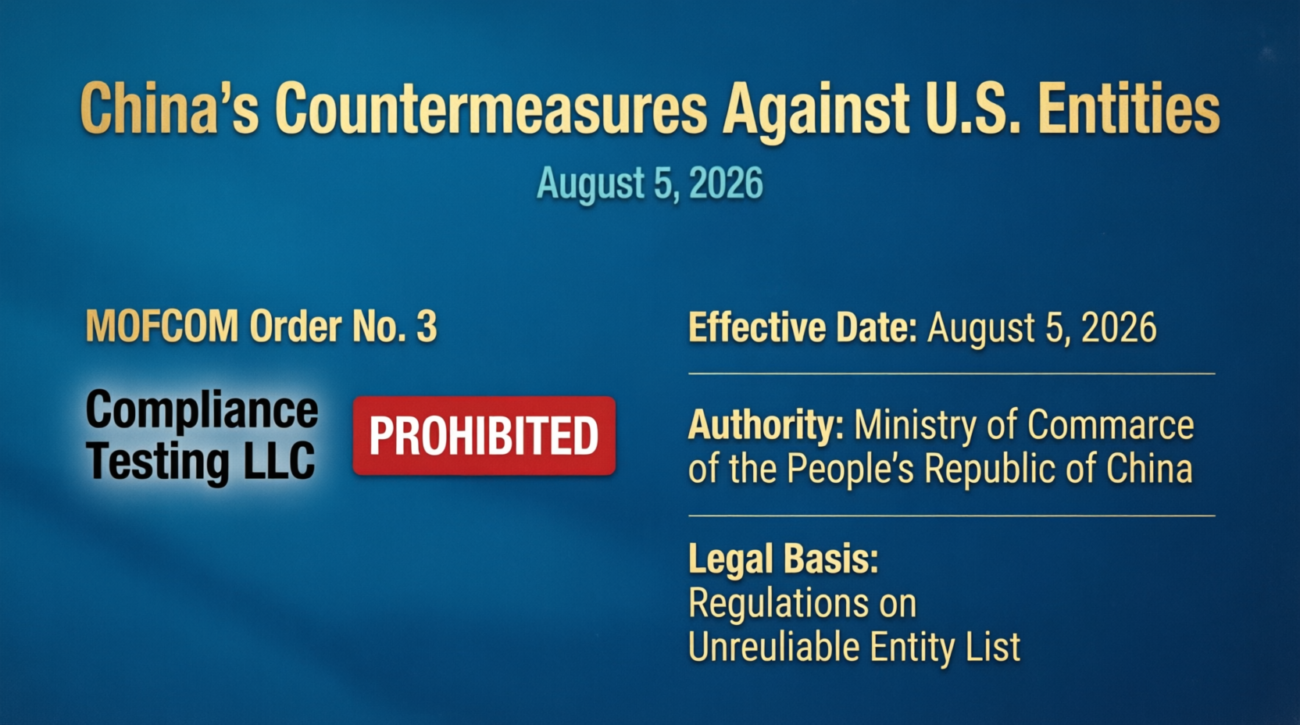
MOFCOM named the firm as having assisted the FCC’s compliance-review process in ways it says undermine China’s sovereignty and development interests. All organisations and individuals in China are now barred from any transaction or cooperation with the company.
- Six further US entities added to the countermeasure list, tied to separate US sanctions actions
- Tightened, case-by-case export controls on dual-use drone components and technology bound for the US
- Suspension of factory follow-up inspections that Chinese CCC-designated bodies had entrusted to US certification firms
- A new national security investigation into imported printers and office equipment
MOFCOM has characterised the package as measured, while signalling that further steps would follow any additional US restrictions. That framing matters for positioning: it reads as a calibrated, reversible response rather than an open-ended escalation — consistent with the pattern China has followed through 2026’s broader counter-sanctions build-out under its Anti-Foreign Sanctions Law and supply chain security regulations.
The countermeasures are generally restrained — but China will take further countermeasures if the United States introduces new restrictions.
Where the Exposure Actually Sits
Zhongji Innolight and Eoptolink both sourced the majority of Q1 2026 revenue from US customers — reported near 62% and roughly 96% respectively — and both saw double-digit share declines on the news, a reminder that the export exposure runs through the supplier, not just the buyer.
Both firms, along with peers including Suzhou TFC, have already stood up production capacity in Thailand — the same Southeast Asia diversification pattern reshaping the wider Physical AI supply chain as manufacturers reduce single-country concentration.
Analysts flagged that a hard import ban would strain the same US data center buildout it aims to protect, given how concentrated high-bandwidth transceiver supply currently is in Chinese hands.
Naming a compliance-testing firm — rather than a chipmaker or lab — signals Beijing is also willing to target the regulatory infrastructure that enables US restrictions, not only the restrictions themselves.
Taken together, the episode is less a single headline than a live illustration of how the AI supply chain’s chokepoints now trigger same-day, multi-front responses. For allocators, the more durable signal isn’t the entity list itself — it’s the direction of travel: component-level restrictions increasingly beget certification-level and entity-level countermeasures within 24 hours, and the manufacturers already diversifying production outside China and the US are the ones best positioned to absorb the next round.
The USINO.AI Daily Brief is complimentary market intelligence for informational purposes only. Nothing herein is investment advice, a solicitation, or a buy/sell recommendation. USINO.AI does not provide regulated financial advisory services. Conduct independent research and seek professional advice. Past performance is not indicative of future results. © 2026 USINO AI PTE. LTD. All rights reserved.