Optimus Trades at 323x P/E on Zero Units — Musk’s Own Words Explain Why
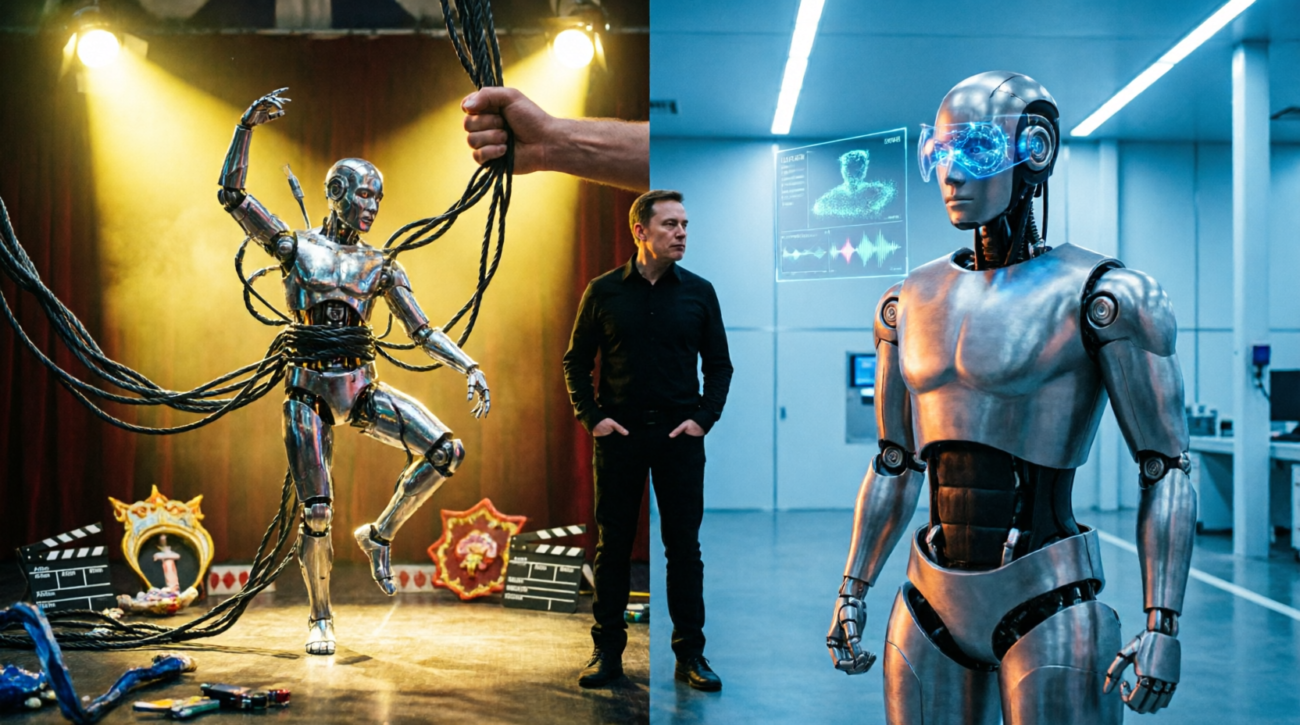
On Tesla’s Q2 2026 earnings call, Elon Musk went after the entire humanoid robotics industry. His claim: most of the “robot folds laundry / robot serves coffee” clips flooding social feeds are not autonomous at all — they’re pre-scripted motion sequences or a human quietly operating the robot by remote, often over VR teleoperation rigs. His evidence: Beijing’s April 2026 humanoid half-marathon, where only 40% of the finishing robots were navigating autonomously; the rest were remote-controlled. He didn’t name every company by title, but XPeng, Unitree, UBTech, Boston Dynamics and Figure all came up in the discussion that followed.
Musk’s bar for what would count as a real general-purpose humanoid: a robot that hears a plain-language instruction, looks at a room it has never seen, and completes the task — no manual programming, no operator standing behind the curtain. His claim was blunt: nobody has cleared that bar yet, anywhere, including every viral demo currently driving humanoid-robotics valuations.
The Charge: “Most of What You’re Seeing Is Acting”
Musk’s framing was pointed: viral robot demos are a funding and attention play, not evidence of capability. Many commercial humanoid platforms ship with VR remote-operation modes; many showcase clips are staged for the camera. Strip away the scripting and the teleoperation, he argued, and today’s “autonomous” humanoid fleet mostly can’t do anything on its own. It’s a fair critique of an industry that has, at times, priced narrative ahead of nines of uptime.
Tesla’s Answer: One Model, Vision and Hearing, No Hand-Coded Behavior
Optimus’s counter-bet is architectural: fold the autonomous-driving stack and the robot’s AI-agent stack into a single foundation model, so the robot learns by observation — sight and sound — the way a person does, rather than through engineers hand-coding each action. Told to “clean up the living room,” the model is meant to perceive the room, plan a route, and execute without supervision. That is the same general-purpose bar Musk set for the rest of the industry, applied to Tesla’s own roadmap.
The Admission That Cuts Both Ways
Musk was candid about the cost of that bet: a mass-producible general-purpose humanoid is, in his words, the hardest product Tesla has ever tried to scale. Optimus runs more than 10,000 unique components, nearly all built from scratch with no existing supply chain to draw on — unlike the century of manufacturing know-how behind a car. He conceded initial production will be “extremely slow.”
That admission lands on the same numbers USINO AI NEXUS’s Tesla Optimus brief already maps: zero Optimus units shipped as of this same earnings call, a hand-mechanism production halt first reported across independent trade press in mid-to-late 2025 that Tesla has still not declared resolved, and a 323x trailing P/E carrying the entire robotics story as pure optionality. Musk’s critique of “remote-controlled theater” may be accurate — but it is an industry-wide indictment that includes the company making it.
Fremont’s converted Model S/X line is guided to begin Optimus production “soon,” with initial units routed to an internal “Optimus Academy” training program rather than customers or factory floors. Tesla also dropped “volume” from its production language versus Q1. The Q3 2026 call is the next checkpoint for whether a confirmed unit count — or a second delay — arrives first.
Autonomy Claims vs. Shipped Reality
- The critique is probably right, and irrelevant to who’s ahead: teleoperation and scripted demos are common industry-wide — that doesn’t hand Tesla the lead, it just resets the bar nobody has cleared.
- “First mover” still isn’t Tesla: Unitree leads on shipped volume, Figure and 1X already have paid pilots, and Agility Robotics has the longest sustained commercial-autonomy track record — all ahead of Optimus’s zero units.
- Optimus’s bet concentrates AI-compute risk: a shared FSD/robotics foundation model means Optimus delays can now credibly compete with FSD for the same training clusters.
- The supply chain is the real story: 10,000+ novel components and an unresolved hand-mechanism halt matter more to the 323x multiple than any rival’s demo reel.
Ticker Watch
TSLA (Nasdaq) Unitree (pre-IPO) UBTECH (9880.HK) Agility Robotics (private) Figure AI (private)
This brief is a companion read to USINO AI NEXUS’s full Tesla Optimus supply-chain teardown — the magnet chokepoint, the regulatory bifurcation, and the production-halt evidence trail behind the 323x multiple. Full 13-page brief available on request via info@usino.ai.