
① Company Watch
🇺🇸 Nvidia — H20 Licences Now Flowing, 2 Million Unit Demand Gap
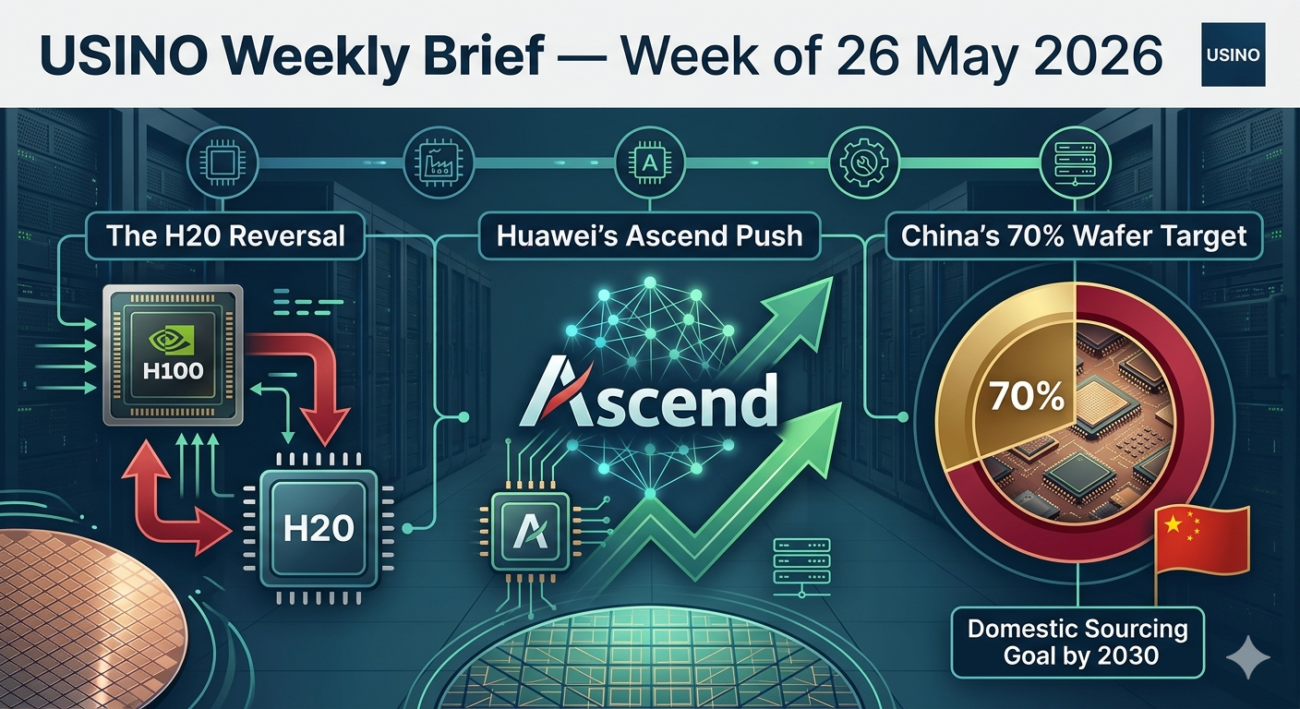
The US Commerce Department has begun issuing export licences allowing Nvidia to sell its H20 GPU into China, following CEO Jensen Huang’s meeting with President Trump. The resumption was framed by the Trump administration as part of negotiations over China’s rare earth magnet export restrictions, drawing bipartisan condemnation from legislators worried about handing Beijing access to advanced AI compute. The demand picture is stark — Chinese tech companies have placed orders for over 2 million H20 units against Nvidia’s current inventory of roughly 700,000. Nvidia has stated that licensed sales to China will have no impact on its ability to supply US customers, arguing that a total export ban only benefits foreign competitors.
🇨🇳 Huawei — Ascend 950PR Outperforms the H20 It Replaces
The Ascend 950PR delivers 2.8x the H20’s FP4 performance — making it the most capable chip available to Chinese AI buyers by a wide margin. Huawei deliberately chose a monolithic die design over multi- chiplet architecture, eliminating dependency on TSMC’s CoWoS advanced packaging, which Huawei cannot access under current sanctions. Huawei is targeting 750,000 Ascend 950PR units in 2026, with full-scale shipments in H2 — but output is expected to fall short of demand. ByteDance has committed $5.6 billion in Ascend 950PR orders — the largest single disclosed domestic chip procurement in China’s history.
🇨🇳 SMIC & Cambricon — Domestic Capacity Under Pressure
As of early 2026, the TSMC die bank that supported Huawei’s Ascend shipments through 2024–2025 is effectively exhausted. Future Ascend production depends entirely on SMIC wafers and domestic HBM packaging. Cambricon is simultaneously targeting 500,000 AI accelerator units from the same SMIC advanced node capacity, with low yields and limited HBM supply as structural constraints. Both companies competing for the same foundry capacity is a tension Beijing has not yet resolved publicly.
🇰🇷 Samsung — Strike Threat Introduces HBM Supply Risk
Samsung’s main union has announced plans for an 18-day strike from 21 May 2026 over a bonus dispute, with Samsung shares falling as much as 9.3% when the union reaffirmed the plan. South Korea’s Labour Commission has called for government-mediated talks. The timing is significant — Samsung and SK Hynix together control approximately 88% of the high-bandwidth memory market that powers AI training and inference globally. Any sustained disruption to Samsung’s HBM production would cascade across Nvidia, AMD, and every AI accelerator dependent on HBM supply. SK Hynix, by contrast, is approaching a $1 trillion market valuation on the back of its HBM dominance — the divergence between the two Korean giants is widening.
② Southeast Asia Watch
This section covers ASEAN as an active participant in the AI supply chain — not merely a bystander to US-China dynamics.
🇲🇾 Malaysia — GPU Re-Export Scrutiny Intensifies
Malaysia has emerged as the most geopolitically sensitive node in Southeast Asia’s AI supply chain. Chinese cloud service providers including ByteDance and Alibaba are accelerating their shift into Malaysia, using the country’s supply chain pathways to deploy high-end AI computing including Nvidia’s B200 systems. ByteDance is accessing a cluster of 36,000 Blackwell B200 GPUs physically located in Malaysia through a local cloud operator — with Nvidia and BIS both confirming the arrangement is compliant with current export controls. However, Malaysia is also investigating an unnamed Chinese company’s potential usage of Nvidia chips banned under US export controls — highlighting the fine line the country is navigating between attracting AI investment and satisfying Washington’s compliance requirements.
🇲🇾🇸🇬🇻🇳 ASEAN — Moving from Assembly to Design
Malaysia unveiled the MARS1000 — its first home-grown edge AI processor — marking a turning point for a region long content to assemble and test chips designed elsewhere. Malaysia has also struck a $250 million technology transfer deal with Arm Holdings and is building a dedicated chip design park. Singapore accounts for roughly 10% of global semiconductor output and 20% of global semiconductor equipment production. SEMICON SEA 2026, held in Kuala Lumpur earlier this month, underscored Southeast Asia’s emergence as an indispensable strategic hub in the global AI compute supply chain — with regional players moving from capacity substitution to technological self-reliance.
③ Policy & Regulatory Move
🇨🇳 China — 70% Domestic Wafer Target, 50% Equipment Mandate
China is targeting more than 70% of silicon wafers used by domestic chipmakers to be sourced locally by end of 2026 — one of the most aggressive localisation milestones set for its chip supply chain. The target is described as an internal government directive rather than a formal public announcement. Separately, Beijing has enforced a mandate requiring domestic chipmakers to source at least 50% of manufacturing equipment from local Chinese suppliers — a structural response to US equipment export controls that directly targets ASML, Applied Materials, and KLA dependency.
④ USINO Take
US Perspective
The H20 licence reversal is a calculated trade — chip access for rare earth concessions. Washington’s calculation is that the H20 is a deliberately capped chip, and allowing its sale preserves diplomatic leverage without conceding leading-edge capability. The Malaysia compliance investigation signals that BIS is watching Southeast Asian re-export pathways closely — the loophole is narrowing.
China / Asia Perspective
The strategic irony is significant. US export controls have done more to accelerate China’s domestic semiconductor ecosystem than any Beijing policy alone could have achieved. The Ascend 950PR outperforms the chip it was meant to replace. Cambricon’s revenue grew over 4,000% in one year. Meanwhile Malaysia and ASEAN are benefiting from both sides simultaneously — attracting US-aligned investment while serving as infrastructure hosts for Chinese cloud operators.
Core Tension
Southeast Asia is now caught between two gravitational forces. Washington wants ASEAN to be a trusted supply chain partner — compliant, export-controlled, aligned. Beijing wants ASEAN data centers and infrastructure to serve Chinese AI compute needs. Malaysia is trying to do both at once. How long that balancing act holds — and whether BIS forces a harder choice — is the defining regional question for the second half of 2026.
⑤ On Our Radar — Week of 26 May
◈ Samsung strike outcome The 18-day strike window runs through early June. Watch for whether South Korea’s Labour Commission mediation produces a settlement. A prolonged strike introduces real HBM supply risk for the entire AI hardware ecosystem — not just Samsung customers.
◈ Malaysia BIS compliance investigation Watch for any formal US communication to Malaysian authorities on GPU re-export compliance. A BIS enforcement action against a Malaysian entity would send a strong signal to the entire ASEAN region about the limits of the China+1 strategy.
◈ China’s H200 import decision Beijing has not yet formally approved H200 imports despite US licences being issued. The decision is a deliberate strategic choice — approving imports may slow domestic chip urgency. Watch for any signal from Chinese regulators or major tech company procurement announcements this week.
Sources: This edition draws on reporting from Reuters, Nikkei Asia, Digitimes, Tom’s Hardware, TechWire Asia, Technology Magazine, Brookings Institution, and official filings from the US Bureau of Industry and Security. USINO applies independent analysis to all sourced material. No content is reproduced verbatim.
USINO Weekly Brief is published every Monday for informational purposes only. It does not constitute investment advice. USINO maintains full editorial independence and has no commercial relationship with any company mentioned.