PCB Supply Chain Disruption:
What It Means for NVDA
PCB Cost Per Rack · Vera Rubin VR200
$35,000 → $116,700
+233% · VR200 NVL72 · Total rack cost ~$7.8M
6
Critical material shortages
29% → 22%
Rubin shipment share revision
2027
Earliest constraint resolution
Aug 26
Next NVDA earnings catalyst
The Setup
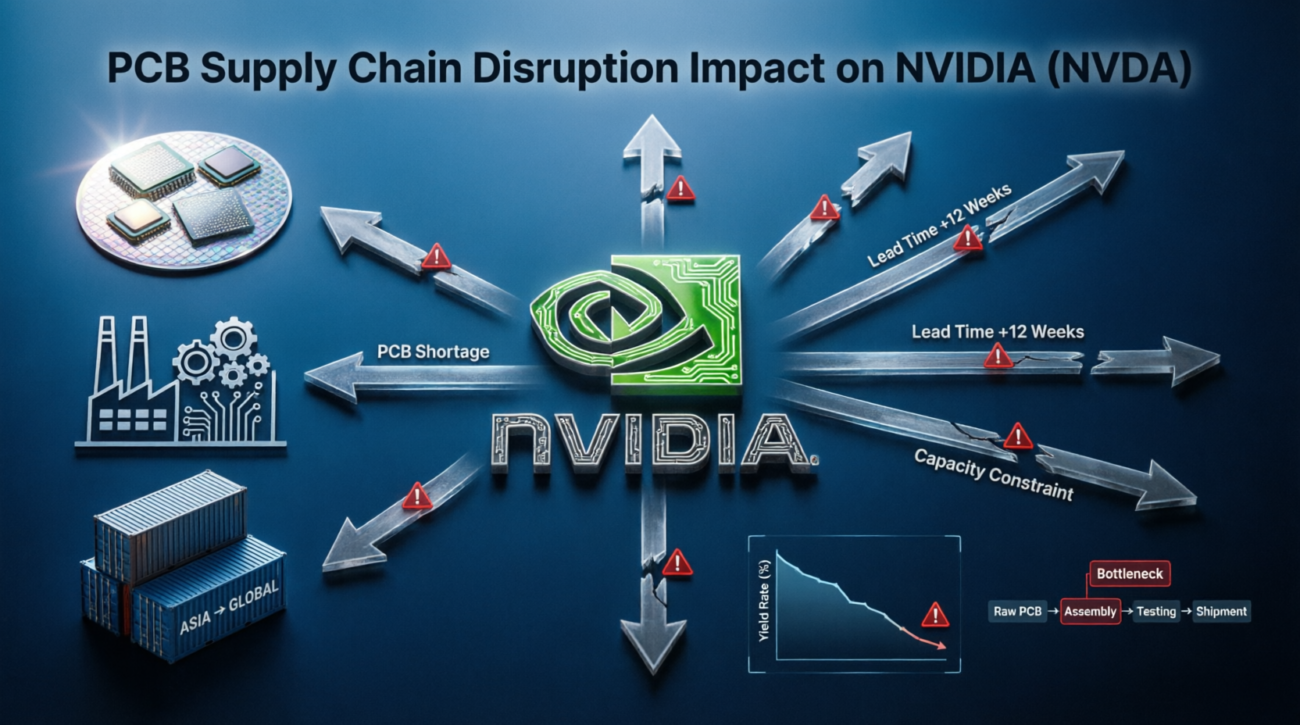
NVIDIA’s Vera Rubin architecture is significantly more powerful than its previous Blackwell line — but power comes with a physical price. The VR200 NVL72 rack costs hyperscalers roughly $7.8 million, nearly double the prior generation, with PCB content alone surging from $35,000 to $116,700 per cabinet. Six raw materials sit at the bottleneck of that manufacturing chain. All six are in structural shortage stretching into 2027.
Six Shortages, One Revenue Problem
60%+
ABF Substrate
Chip packaging foundation. Taiwanese capacity fully locked to NVIDIA & AMD through 2027. No meaningful new supply before then.
45–65%
T-Glass Cloth (Low-CTE)
Structural skeleton of high-end CCLs. Japan’s sole major supplier holds ~90% global share. Competitor capacity not online until 2027.
40–55%
M9 Hydrocarbon Resin
Mandatory for next-gen high-frequency laminates. Only two suppliers globally hold NVIDIA’s M9 certification. A duopoly at the material base.
30%+
PCB Drill Bits
Now consumed as high-frequency disposables. AI server PCBs require micro-holes at 40:1 aspect ratios — consuming drill bits at unprecedented rates.
15–25%
HVLP4 Copper Foil
Customer validations for alternative suppliers only completing now in mid-2026. H2 supply remains constrained.
Tight
Spherical Silica Powder
Required at 40% fill ratios for M9/M10-platform laminates. Domestic alternatives still maturing through 2026.
What This Means for NVDA at $200
Gross Margin Pressure
A 233% increase in PCB BOM forces NVIDIA to absorb costs or test the price elasticity of hyperscalers running tight CapEx budgets. Pricing power is real — but not infinite at $7.8M per rack.
Revenue Timing Risk
Rubin shipment share revised from 29% to 22% for late 2026. T-glass cloth and M9 resin constraints are the primary causes. This is a quarter-delay, not a cancellation. Demand is intact.
Execution Risk Migrates Down
A single defective layer in a 26-layer HDI board can invalidate an entire NVL72 cabinet. NVIDIA is increasingly behaving as an industrial conglomerate — directly intervening in raw material allocation.
The Taiwanese Supplier Ceiling
The two primary Taiwanese PCB and substrate names — Unimicron (3037.TW, ~NT$968) and Nan Ya PCB (8046, ~NT$819) — are already running at effective capacity ceilings locked to NVIDIA and AMD. Unimicron shares have outperformed the developed Asia Pacific index by over 187% in the past six months. The upside from here is constrained precisely because the story is already priced: capacity locked = revenue visible = multiple largely awarded. These are now yield plays, not growth plays.
USINO.AI View
The NVDA thesis is not broken — 38 analysts maintain a Strong Buy consensus with a $298.87 price target. But the street’s $391.3B FY2027 revenue consensus was built on a 29% Rubin ramp the physical supply chain cannot currently support. The primary risk is not demand destruction. It is quarter-slip. At $200, NVDA is trading at its all-time high support level. Watch the August 26 earnings call for any language on Rubin delivery phasing. The Taiwanese substrate plays are fully valued at current capacity locks.
L2 Intelligence · Paid Tier
Who Are the Chinese Companies Benefiting from This Disruption?
NVIDIA’s forced diversification away from fully-locked Taiwanese primary suppliers is creating a secondary beneficiary layer — a cluster of listed Chinese A-share manufacturers in FC-BGA substrates, M9-grade resin, spherical silica powder, PCB micro-drill bits, and HVLP4 copper foil. These are the names NVIDIA is actively qualifying as regional redundancy partners, with direct capital injection accelerating their certification timelines.
USINO.AI L2 subscribers receive full company names, Chinese tickers, individual monitoring frameworks, and USINO.AI VIEW analysis for each name in the beneficiary chain — including the single highest-conviction structural moat position in the entire PCB materials stack.
Subscribe to Unlock L2