
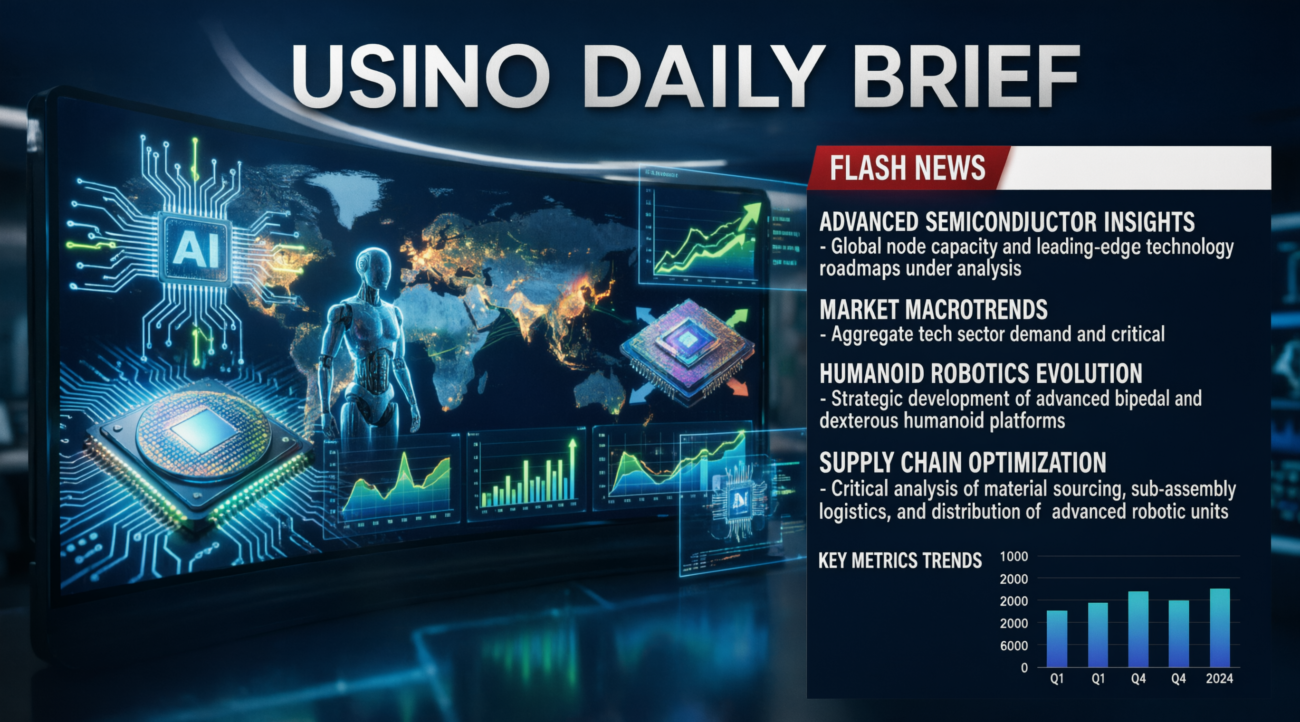
$900M for XPeng’s Robots, a 45% Unitree Selloff, and Three New Chips: China’s AI Stack Doesn’t Wait for the Market to Agree on a Price
Ten stories crossed the desk in the past 24 hours, and they split cleanly into two narratives that are actually one narrative. On the equity side, Unitree’s post-IPO stock is round-tripping toward earth while XPeng just closed the largest single private round China’s embodied-intelligence sector has seen, at a valuation north of $6.3 billion. On the hardware side, Huawei, Xiaomi, and Enflame all advanced China’s domestic compute stack in the same 48-hour window, backed by a fresh MIIT subsidy scheme for humanoid components — even as Washington moved in July to keep Chinese-made robots out of the U.S. market entirely.
None of this resolves the question the market is actually asking: which of these valuations are real. But the supply chain read is unambiguous — capital, policy, and component localization are all still accelerating, regardless of what Unitree’s ticker did this week.
Capital Keeps Moving Even as Unitree Cools
XPeng’s humanoid unit closed its first equity round on August 24 at over $900 million, led by IDG Capital with Tencent and Alibaba as strategic participants — a post-money valuation above $6.3 billion (~RMB 43 billion) that sets a new single-round record for China’s embodied-intelligence sector. The IRON humanoid robot is slated for mass production by end-2026 and delivery in 2027. The deal reinforces automakers’ spillover into robotics: the China Auto Parts ETF (562700) outperformed on the news, and Zhejiang Shibao (SH: 002703) surged almost 10% as actuator, reducer, and sensor suppliers picked up incremental demand.
That’s the bull case running in parallel with a much rougher one. Unitree Robotics (688836.SH), which opened at RMB 1,100 on its August 19 STAR Market debut — a 629% pop from its RMB 150.8 IPO price and a peak market cap of RMB 444.9 billion — closed August 24 at RMB 603.08, down 45% from the peak and erasing over RMB 200 billion of market value in four trading days. The read here isn’t that the humanoid thesis is broken; it’s that the secondary market has stopped paying a scarcity premium and started asking for order books. AgiBot (Zhiyuan Robot) is the company best positioned to answer that question today: it has now produced more than 10,000 humanoid units cumulatively in 2026, the global shipment lead, and has opened a Hong Kong listing process targeting a HKD 40-50 billion valuation. Separately, DeepSeek is reportedly advancing a new round at a ~RMB 500 billion pre-money valuation, and Moonshot AI has launched a Pre-IPO round targeting a $50 billion (~RMB 340 billion) pre-money valuation — both a direct read-through into compute procurement demand.
The Domestic Chip Stack Advances on Three Fronts
While the robotics equity story played out, three separate moves pushed China’s compute independence forward. Enflame Technology (688801.SH) filed its STAR Market prospectus on the evening of August 24, targeting an RMB 6 billion raise for 5th- and 6th-generation AI chip R&D and industrialization; preliminary inquiry is August 28 with subscription on September 2. H1 2026 revenue reached RMB 1.12 billion, and the company guides Q1-Q3 revenue of RMB 2.3-3.0 billion, up more than 325% year-over-year. Huawei formally launched the Ascend 950 the same window, built on a third-generation DaVinci Core architecture delivering 804 TFLOPS of FP8 compute and up to 4 TB/s of memory bandwidth, designed to anchor thousand-card-scale super-nodes. And at its Xuanjie chip briefing, Xiaomi unveiled three self-developed chips spanning AI smartphones, high-bandwidth computing, and intelligent driving — including the Xuanjie O100, a dedicated large-model AI accelerator built on a 6nm 3D wafer-on-wafer stack with 1.22 TB/s of bandwidth.
Terminal makers self-developing silicon extends AI compute from cloud to edge and pulls demand toward domestic chip design and advanced packaging — the 3D stacking Xiaomi is now using is the same capability class that will matter for the memory bottleneck below.
Policy Widens the Runway at Home, Washington Narrows It Abroad
MIIT’s Equipment Industry Department issued “first-set” certification rules for humanoid robots on a 2026 basis, placing complete units and their core components into the national first-set insurance compensation and government procurement priority catalog, with subsidies up to RMB 3 million per unit and the first application window opening September 15. That’s policy support moving from R&D funding into direct procurement cost reduction — a lever that compounds with the localization rate, which has already risen from under 50% to over 90% for core humanoid components.
Set against that is the FCC’s July action effectively blocking new foreign-made humanoid robots and other advanced robotics from entering the U.S. market. The dependency the ban is trying to sever is real: U.S. robotics manufacturing relies on Chinese-sourced motors, chassis, batteries, and sensors that run 5 to 10 times cheaper than U.S. domestic alternatives, and China controls up to 90% of permanent magnet processing technology. In the near term this closes off overseas expansion for some Chinese OEMs; it does not touch the cost and capacity advantage that made the ban necessary in the first place.
Two dates converge in the next three weeks: Enflame’s STAR Market subscription on September 2 and MIIT’s first-set subsidy application window opening September 15. The first is a market test of whether investors will pay up for a fourth domestic GPU listing after Unitree’s post-IPO correction; the second is the first real-money test of whether subsidy demand actually pulls forward humanoid component orders.
Upstream Bottleneck: Memory and Substrates Become the Chokepoint
The constraint is migrating up the stack. Rising demand for high-density interconnection, HBM, and multi-die integration is making packaging substrate materials the newest supply chain hurdle, and memory cost inflation is now reshaping AI hardware pricing outright — memory alone accounts for close to a quarter of an AI server’s total cost. Nvidia has already cut SOCAMM module capacity per Vera CPU in its Vera Rubin platform by half to manage LPDDR5X shortages and cost pressure. That constraint will propagate straight through the humanoid robot and AI server supply chains covered above, raising the strategic value of domestic HBM and advanced packaging substrate capacity and narrowing the window for substitution before Western supply normalizes.
- Capital rotation, not a slowdown: Unitree’s correction is a repricing of scarcity, not a verdict on the sector — XPeng’s $6.3B round and AgiBot’s 10,000-unit milestone both landed in the same week.
- Localization is compounding with policy: component localization above 90% plus a per-unit subsidy of up to RMB 3 million means the cost advantage over Western hardware is now state-subsidized on top of already being structural.
- Three chipmakers, one week: Enflame’s IPO, Huawei’s Ascend 950, and Xiaomi’s Xuanjie chips all advanced in the same 48 hours — domestic compute independence is being built on multiple fronts simultaneously, not sequentially.
- The U.S. wall raises the stakes on domestic demand: with the FCC effectively closing the U.S. market, China’s humanoid OEMs now need the domestic subsidy and procurement pipeline to carry volume that export markets can no longer absorb.
- The bottleneck is moving upstream: as chip compute scales, memory and substrate capacity — not chip design — become the binding constraint on both AI servers and humanoid robots.
Ticker Watch
XPeng (09868.HK / XPEV.US) Unitree (688836.SH) Enflame Technology (688801.SH, IPO pending) AgiBot / Zhiyuan (pre-IPO, HK-bound) Huawei (Ascend, private) Xiaomi (01810.HK) China Auto Parts ETF (562700) Zhejiang Shibao (002703.SH)
USINO.AI tracks the global supply chain behind every Physical AI and compute headline — components, capacity, and the companies the market hasn’t priced yet. Deeper coverage of today’s supplier moves is available in the USINO AI NEXUS.