
USINO.AI · Compute & Chips
Beyond the Screen: A Beginner’s Guide to Virtual and Physical AI
AI is not a software upgrade. It is the infrastructure of a new economic epoch — one that bridges the digital mind and the physical world. The question for investors and business leaders is no longer whether this shift will happen. It is whether they will be positioned to capture it.
There is a profound fatigue settling over the global business community regarding Artificial Intelligence. Years of headlines about text generators and coding assistants — alongside sensationalist warnings about job displacement — have obscured something far more consequential.
The real transformation is not happening on a screen. It is happening in global supply chains, in heavy manufacturing plants, and inside molecular research laboratories. This is a business and economic shift of the first order — one that rewrites the classical variables of production and opens entirely new arenas for capital formation. The companies that identify and position themselves correctly in this new architecture will define the next era of wealth creation.
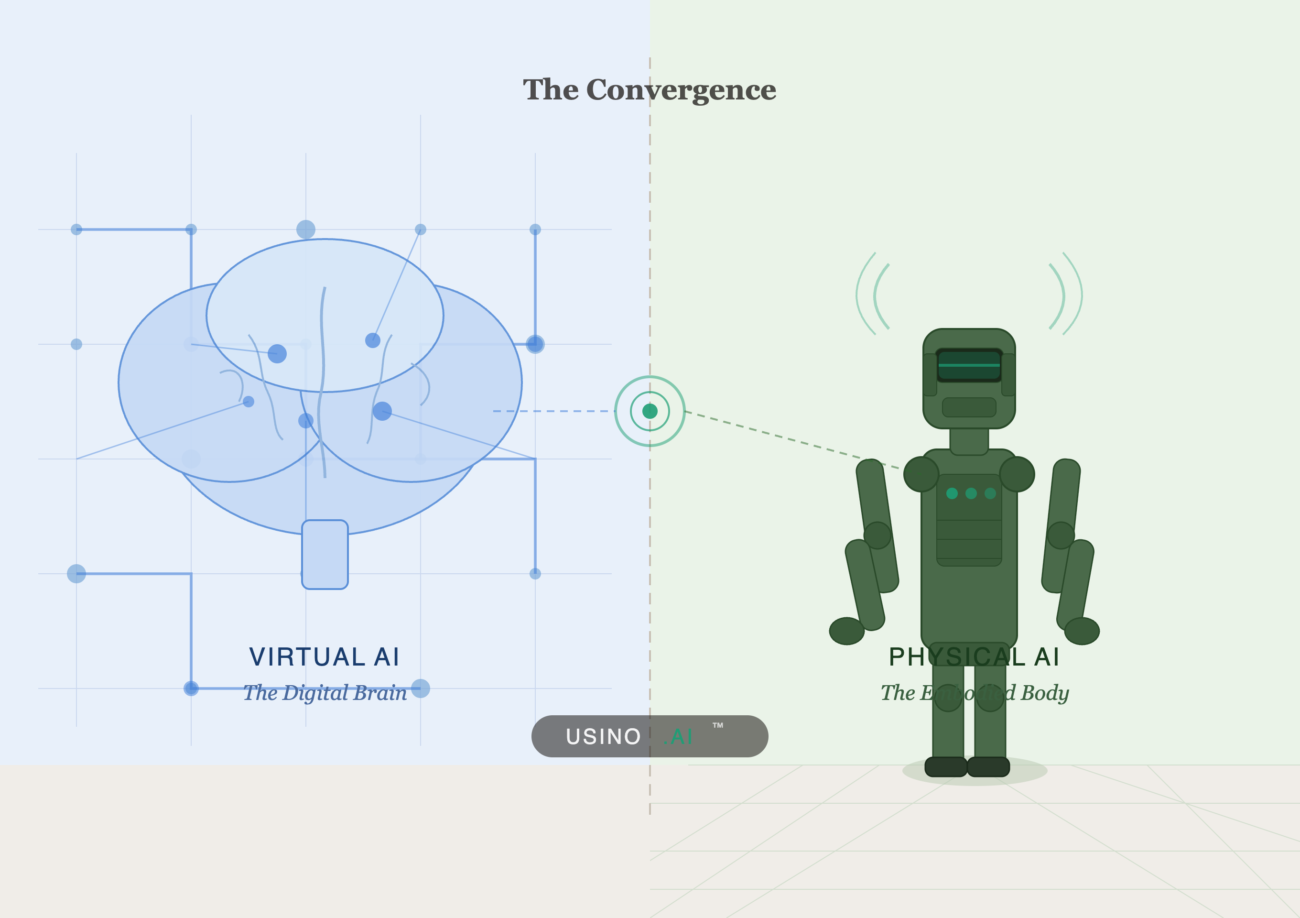
To navigate this landscape, we must learn to divide AI into two distinct, deeply connected halves: Virtual AI — the Brain — and Physical AI — the Body.
How AI Redefines the Classical Variables of Production
Wealth has always been generated by optimising land, labour, and capital. The convergence of software and machinery is restructuring these pillars simultaneously — disrupting the labour and capital axes in ways no single technology has done before.
Moving from reactive logistics — fixing bottlenecks after they occur — to predictive autonomous flows that dissolve friction before it forms.
Physics-informed neural networks simulate millions of molecular combinations in days, accelerating the discovery of solid-state batteries, lightweight composites, and self-healing polymers.
Replacing rigid automation with intelligent cobots that observe, recalculate, and correct in real-time — operating safely alongside human workers without bespoke reprogramming.
Virtual AI: the Digital Brain
Virtual AI exists entirely within the digital realm. It is software-based, living in the cloud or on enterprise servers. It processes massive amounts of unstructured data, recognises patterns, generates content, and makes high-level decisions — but it cannot physically interact with the world.
Predictive logistics: AI systems that forecast demand and reposition inventory autonomously, preventing capital from being trapped in transit.
Risk management: Algorithms monitoring millions of financial transactions in real-time to detect fraud and market anomalies.
Enterprise automation: Virtual agents analysing legal contracts, generating compliance reports, and automating complex workflows.
Physical AI: the Embodied Body
Physical AI bridges the digital and physical divide by merging intelligence with specialised hardware — sensors to perceive the real world, and actuators to interact with it. If Virtual AI lives in the cloud, Physical AI lives in the room with you.
The humanoid transition is now measurable. In 2025, the first companies crossed from prototype into factory-scale deployment — delivering over one thousand industrial units into automotive, semiconductor, and logistics facilities. The pilot era is ending. The production era has begun.
Autonomous mobile robots (AMRs): Warehouse logistics vehicles navigating unstructured floors to pick, sort, and transport goods without human intervention.
Precision agriculture: Autonomous drones with computer vision evaluating crops frame-by-frame, applying inputs only where needed.
Industrial humanoids: Bipedal robots designed to operate within infrastructure built for humans — climbing stairs, handling tools, executing factory tasks.
When the Brain Downloads into the Body
Historically, robotics and software were entirely decoupled. A robot had to be manually programmed with thousands of lines of explicit code just to move an object from Point A to Point B. If the environment changed by a fraction of an inch, the robot failed.
Today, when a robot encounters an unexpected obstacle on a factory floor, it does not freeze. Its physical sensors feed data to its virtual brain — which recalculates a new path and executes the correction in real-time. An operator can simply say: “Clear the debris from loading dock four.” The physical AI handles interpretation, planning, and execution on its own.
This shift from automation to autonomy — from muscle without adaptability to intelligence with a body — is the defining industrial transition of the 2020s. The breakthrough is not happening within either field in isolation. It is happening at the intersection.
Not a Duopoly — A Web of Chokepoints
The convenient narrative frames this as a two-player contest between the United States and China. That framing has editorial clarity — but it obscures where the real leverage actually sits. The Physical AI supply chain is not a rivalry between two nations. It is a web of critical dependencies, each controlled by a different part of the world. Understanding who holds which chokepoint is the foundation of any serious investment view.
Silicon Valley commands foundational model design, semiconductor IP, and the cloud infrastructure that trains the models powering both virtual and physical intelligence. The US writes the operating system; the rest of the world runs on it.
Beijing has designated Embodied AI a national priority. China’s dominant EV supply chain — precision actuators, high-density batteries, electric motors — is structurally identical to the stack required to mass-produce humanoid robots. No other nation can match its hardware scaling velocity.
TSMC manufactures the chips that make both the Brain and the Body run. Without Taiwanese fabrication, neither US foundation models nor Chinese humanoid fleets scale at current trajectories. Taiwan is not a player in the contest — it is the terrain the contest is being fought over.
Japan built the modern robotics industry. Fanuc, Yaskawa, and Kawasaki dominate industrial robot installations globally. South Korea supplies the memory — Samsung and SK Hynix produce the HBM chips without which AI inference cannot run. The entire compute stack depends on Korean silicon.
Germany and Switzerland hold commanding positions in precision actuators, grippers, and industrial mechanics — the components that give robots dexterity. ABB, KUKA, Festo, and Schunk supply critical hardware to every major robotics programme globally, regardless of national allegiance.
Vietnam, Malaysia, and Thailand are absorbing supply chain diversification as both US and Chinese manufacturers reduce single-country exposure. Malaysia hosts significant semiconductor back-end packaging. This is where the next layer of Physical AI infrastructure is being quietly assembled.
The investor who maps only two poles will miss the chokepoints. The fabrication bottleneck is in Taiwan. The memory constraint is in Korea. The precision mechanics advantage is in Europe. The volume scaling engine is in China. And the software architecture that ties it all together originates in the United States. Identifying the companies that control these nodes — across all geographies — is precisely what separates informed capital allocation from noise.
The future does not belong to passive observers. It belongs to the investors, builders, and leaders who understand — right now — the full architecture of this new global economy.
USINO.AI · Premium Research
Subscribe to Receive the Premium Report Notification
Our premium research names the exact listed stocks, pre-IPO unicorns, and supply chain component plays across US and Asia capturing this shift.
- The US Architecture: We profile the semiconductor giant providing the universal operating system for machines, the EV pioneer scaling humanoids using automotive infrastructure, and the private warehouse tech titans backed by Silicon Valley’s elite.
- The Asian Supply Chain Frontier: We map the world’s first pure-play humanoid company trading publicly in Hong Kong, the Korean memory giants underpinning every AI inference stack, the Taiwanese fabrication chokepoint no roadmap can ignore, and the Chinese EV manufacturers cross-investing in physical AI at national-priority scale.